TL;DR: The Myth of Accurate Crime Statistics
Official FBI crime statistics are significantly undercounting the reality of violence in America. Since the 2021 transition to a new reporting system (NIBRS), thousands of agencies—including major hubs like the NYPD and LAPD—have failed to report their data. In Florida, less than 10% of agencies contribute to national figures. This data gap means that “official” murder rates are likely much higher than reported, making personal vigilance and skepticism of government “facts” more important than ever.
Why We Should Not Rely on Crime Data Reports
When I consider the number of murder cases I handle a year and compare it to the FBI statistics, it is obvious murders and crimes in general are not being reported to the FBI by State and local law enforcement agencies, In 2023, Florida reported 1,066 murders according to Statista. Nationally there were 17,713 murders according to the FBI. If these reports were correct, it would mean my agency, Prodigy Investigative Group handled 1.9% of the murder cases in Florida and .11% of the murders nationally in 2023. Most private investigators do not handle criminal cases and even more do not handle murder cases, I can confidently state by the number of criminal defense attorneys who handle murder cases that I know, the murder rate is substantially higher than what is reported to the FBI.
The FBI has been the gold standard for crime statistic trough their Uniform Crime Reporting Program for over 100 years. These FBI statistics are relied upon by politicians and other community leaders when analyzing the needs for criminal reform. How can we effectively determine the best crime reform when we do not have accurate numbers? In 2021 the FBI modernized the reporting system for law enforcement agencies and ceased their former system entirely. The reporting of crimes by law enforcement agencies declined considerably because agencies were not up to speed on the changes the FBI made.
There are approximately 18,000 law enforcement agencies in the U.S. One-third of these agencies are not reporting to the FBI’s crime database. Less than 10% of the law enforcement agencies in Florida and Pennsylvania’s crime data are part into the national figures. In 2021, Florida and California were the only two states who were not FBI certified in the new data collection system so neither state submitted any crime data. This makes a significant impact of the accuracy of the data put out by the FBI. In 2022, the New York Police Department, Los Angeles Police Department, Phoenix Police Department, Suffolk and Nassau Counties in NY, San Jose Police Department, and Hillsborough County Sheriff were among those whose crime stats were not reported to the FBI. These agencies’ jurisdictions are known for high crime. The following maps published by The Marshall Project reflect the law enforcement agencies participation in reporting crimes within their jurisdiction to the FBI.
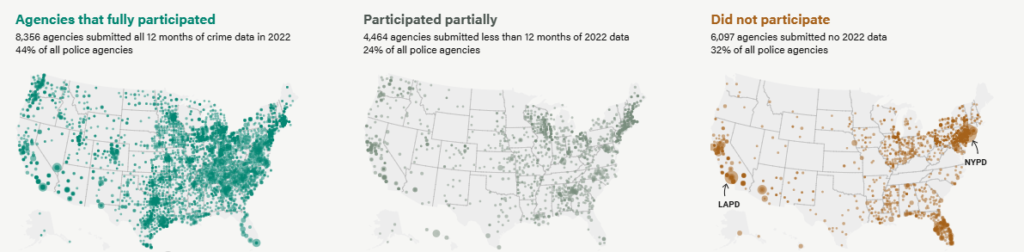
Source: Agency participation data compiled by the Federal Bureau of Investigation on Feb. 6, 2023, which was the deadline for local agencies to submit crime data for the Q4 2022 quarterly report. Local agencies had until April 3, 2023 to submit data for the FBI’s 2022 national crime report, so the final participation status may change. Map only shows law enforcement agencies that police more than 5,000 people. *The Marshall Project
What does this all mean? It is simple. Stop believing everything you hear and the scaled down version of what you are shown and always be attentive in protecting yourself, your family and friends so you do not fall victim to another’s evil intentions. Although too many people struggle to accept they cannot trust the information put out by the news and government, it is a fact that we are never told the entire truth and the “facts” as these entities push on us should be considered highly fallible.
Frequently Asked Questions
1. Why are FBI crime statistics considered inaccurate?
The FBI relies on voluntary reporting from approximately 18,000 law enforcement agencies. Currently, about one-third of these agencies do not report their data. Because large, high-crime jurisdictions often fail to submit figures, the “national” statistics often reflect a scaled-down version of reality.
2. What happened to the FBI reporting system in 2021?
The FBI modernized its system in 2021, switching to the National Incident-Based Reporting System (NIBRS). Many agencies were not prepared for the technical requirements of this shift, leading to a massive decline in participation and a “black hole” in national crime data for states like Florida and California.
3. How much of Florida’s crime data is actually reported to the FBI?
Less than 10% of law enforcement agencies in Florida are currently reflected in national figures. In fact, in 2021, Florida was not FBI-certified in the new data collection system, resulting in zero crime data being submitted to the national database for that year.
4. Does the size of a city affect its crime reporting?
Surprisingly, yes. Some of the largest agencies in the country, including the NYPD and LAPD, have had years where their data was not fully integrated into the FBI’s annual reports. This means the most populated (and often highest-crime) areas are frequently missing from the “official” record.
5. How should I interpret news reports about “falling crime rates”?
Always consider the source and the data participation levels. If a report says crime is down but major cities in that state didn’t report their data, the “fact” is fallible. Personal safety should be based on situational awareness and professional investigative reality, not just government-issued spreadsheets.